Commentary: Don’t stash your child’s hongbao money in the bank. Give them a chance to spend it
SINGAPORE: With Chinese New year closing in on us, have you lot given thought as to how to handle your children'south hongbao money?
Some parents let their children free rein and then wonder what they did with all that cash.
Others sweep upward (and bank in) all of the hongbao money fifty-fifty faster than you lot tin can say gong xi fa cai, for saving towards their children'south didactics.
Only in today'southward consumer-driven, online shopping world, are these strategies plenty?
TO STASH OR TO SPEND
Every Chinese New Year, we set aside a large portion of their hongbao money for saving.
Because this runs into the hundreds, we will bank it into our family business relationship, and enter the amounts into a savings spreadsheet, so that the kids can visually runway their savings growth. We besides offer them an bonny interest charge per unit.
Then we give them S$20 to spend on annihilation their hearts desire.
Simply why allow them to spend South$20? Isn't it best to save everything for a rainy day?
I'grand non arguing against saving, just I'm not sure if swiftly sweeping the hongbao dollars away into a bank business relationship, safely hidden and out of reach, actually helps a child understand its value.
For us, it'southward important to give our children some grade of practice with managing common cold difficult cash.
We all know that children larn better when dealing with concrete things. They besides learn well through making mistakes.
So what better time to let them handle a bundle of crisp dollar notes than at CNY?
If they don't become whatsoever coin to spend at all, so nosotros should be asking: What other opportunities are there for them to practise making money decisions?
In this 24-hour interval and historic period where y'all tin can purchase anything at the click of a button, over-controlling their hongbao collection may deprive them of a golden learning opportunity – ane that goes across the well-contained boundaries of the weekly allowance.
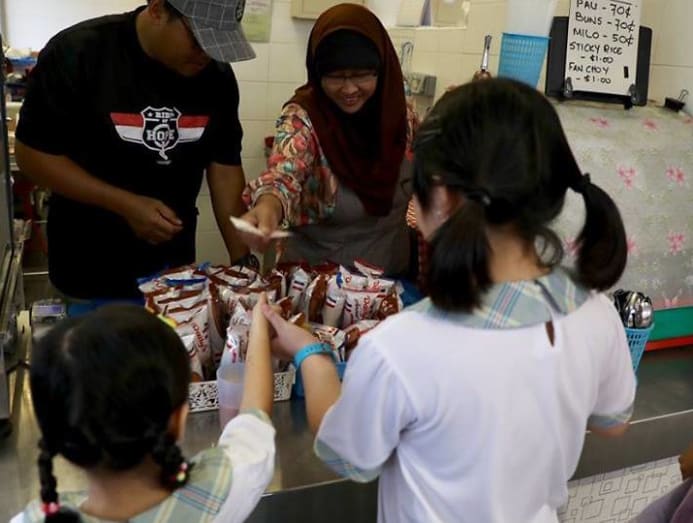
Coin SENSIBILITIES Offset EARLY
Children tin can develop sensitivities towards money from a very early age.
I was having tea with my girl some time ago, when she glanced at my receipt and discovered that I'd been charged for two cups of tea when I only ordered one.
At Principal Two, she was even more than vigilant about money than I was. (I didn't even take a second look at the receipt.)
We didn't do a lot at that time to train her well-nigh money. What nosotros did was use every week's allowance to teach her how to allocate her leftover coins into her three piggy banks: Salve, Share, and Spend.
READ: The year of trials and tribulations, as the parent of a newborn, a commentary
The pre-school and early primary ages are the all-time years for picking up healthy money habits.
Don't wait till they striking adolescence to focus on these skills, as it will exist all too easy and so to give in to temptations in the form of the latest fashion or status symbols.
This is why we're affording them this small luxury at Chinese New year's day; we want them to exercise making purchasing decisions.
Along the manner, we guide them by asking questions such as: Are we really stretching our dollar? Are there better value options around? Or is it applied to accept in our abode?
We also allow them to make mistakes.
READ: Learning to permit go as a parent of a Primary 1 kid, a commentary
What they do with the S$20 can be very telling.
Sometimes they get distracted from their goal of a book or toy they've been wanting to get, and start spending on a snack or some pretty stationery. Without proper planning, they may finish upwards not having enough for whatever they had planned on getting in the first place. They volition have to alive with the consequences.
Such mistakes are invaluable in teaching them essential planning and budgeting skills. It's better that they make mistakes with Southward$20 now than for them to suffer fiscal losses in the range of thousands after.

Chinese New Year isn't the merely time where they get to practise making money decisions.
Every year, we work with our children to ready ii savings goals, where they are immune to apply their savings to buy 2 items over the form of the yr. These items are capped at S$50 maximum value.
These are opportunities for united states to guide them – not just in saving, only also in spending.
Setting brusque-term goals gives them the motivation to relieve, knowing that they are working towards something that can be realised in the most futurity.
Through such planning and goal-oriented habits, our children are practising the skill of delaying gratification.
Information technology also helps u.s. avoid the head-to-caput battles that are ofttimes seen in toy stores on weekends – the one where the kid cries: "I desire it at present!"
In a world dominated past instant gratification and with a host of entertainment and pleasure options, delayed gratification is arguably 1 of the most crucial skills for a kid to have.
READ: This festive season, parents should exercise cocky-control in giving, a commentary
ESTABLISHING PRUDENT Money HABITS
Warren Buffett once said:
The financial habits yous develop when you are young are going to go with you into your machismo.
Y'all only demand to look around you to see that this is truthful.
So whether you allow your child S$ii or Southward$200 from their hongbao money, what matters is that they get hands-on with managing it.
We tin can as well use examples from everyday life to teach our kids.
For case, how are our children using their money at school? Do they think to save a portion of their allowance at the end of the week, or set information technology aside for a goal?
When we're at the supermarket, do we teach them to compare prices with the value or weight of the grocery items?
Teaching children coin skills is an ongoing conversation. One where we can encourage them to question our purchases to gain insights into what we value and how we brand decisions every bit a family unit.
It also has to come through the real-life experience of managing, and sometimes mis-managing, a small sum of money.
With practice, the next generation will come to internalise the value of saving and spending wisely, grow more generous towards others, and not blitz into making financial commitments with money they don't have.
June Yong is a female parent of three, an educational therapist and owner of Mama Habiliment Papa Shirt, a blog that discusses parenting and education in Singapore.
Source: https://cnalifestyle.channelnewsasia.com/commentary/hongbao-money-chinese-new-year-how-much-to-let-child-keep-255956
0 Response to "Commentary: Don’t stash your child’s hongbao money in the bank. Give them a chance to spend it"
Post a Comment